info@zinavo.com
 Call Us

Introduction
The importance of digital visibility in 2026 goes beyond Google’s traditional search engine result pages (SERPs). Businesses must now deal with generative AI large language models (LLMs), chatbots, AI assistants and search engines that synthesize answers rather than just listing links. How do you ensure your brand appears in AI-driven answers? “AI visibility” plays a role here.
According to industry research, “AI visibility” refers to how often your brand is mentioned or recommended in responses generated by AI systems such as ChatGPT, Claude, Gemini and Google’s featured-AI result panels. Digital strategy is quickly becoming a mission-critical dimension for many companies, particularly B2B, SaaS and enterprise brands.
The following steps will be outlined in this blog:
- Why AI visibility matters in 2026
- Key features to look for when selecting an AI visibility tool
- A review of the top platforms making waves right now.
- Practical tips for getting started.
- Looking forward to the future.
The importance of visibility in AI
1. Search is evolving
Traditional SEO strategy is focused on getting ranked on Google’s first page, driving clicks to your site and converting. The number of users who get their answers directly inside chatbots or AI-powered panels has grown significantly over the past few years. One article states that “AI-generated answers appear to feature brands with more authority.”
That means showing up in AI results is just as important as (if not more than) traditional web ranking.
2. New “zero-click” pathways
The visibility of your brand will still matter when an AI system answers a query and provides recommendations without the user having to click through to a website. The company whose content is used by AI gets “indirect exposure” and influence. Tools that help you monitor this visibility and give you insights into that unseen dimension of web traffic and brand presence.
3. Competitive advantage
The risk of falling behind your competitors if you do not use AI visibility tools for tracking how your brand appears in AI search, mentions and prompt answers is high.
4. Insight into how AI “talks about” you
The tools not only tell you if you have been mentioned but also how you have been mentioned, the sentiment, the associated topics and the sources that the AI uses to reference your brand. This helps shape your content strategy, positioning and narrative in the age of generative AI.
What to Look for in an AI Visibility Tool
Choosing the right tool is critical. According to industry guidance, here are the key factors to consider:
Coverage of AI platforms / LLMs
Does the tool track visibility across multiple generative engines (ChatGPT, Claude, Google AI Overviews, Perplexity, Gemini, etc.) or is it limited to one or two? A broader coverage gives you full insights.
Metrics you can trust
It’s not enough to just track “brand mentions.” Useful tools will give you share-of-voice (SOV) in AI responses, citation sources, sentiment, topic associations and competitor benchmarks.
Historical & competitive benchmarking
The tools you need will provide statistics over time (so you can see whether your brand’s visibility is improving or declining) and the ability to analyze your brand compared to those of your competitors.
Actionable insights & optimization guidance
A good tool doesn’t just show data it should help you act on content gaps, prompt optimization strategies and identify citation-source opportunities.
Usability & ROI
Particularly for smaller businesses or agencies, consider the ease of use, onboarding time, budget alignment, and how you measure ROI (traffic lift, brand lift, improved citations).
Integration with existing workflows
Since AI visibility sits somewhere between SEO, content marketing and brand monitoring, you’ll want tools that plug into your workflow: dashboards you use, exportable reports, alerts, etc.
Top AI Visibility Tools to Consider in 2026
Here are some of the standout platforms that are leading the charge right now.
1. Semrush AIO
Semrush’s Advanced AI-Visibility and “Answer Engine Optimization” platform is regarded as one of the most comprehensive on the market. The tool tracks how your brand appears in AI-generated answers, identifies keywords that trigger AI-overview features and compares your brand with competitors.
Highlights:
- Tracks multiple LLMs and AI overview features (e.g., Google AI Overviews)
- Strong data backing and an established brand in SEO tool space
Use case: Ideal for medium to large businesses that already use Semrush and want to expand into AI visibility.
2. HubSpot AI Search Grader
HubSpot offers a free tool that audits your brand visibility in the AI space. It dives into how often you’re mentioned in AI responses, your share of voice versus competitors, and sentiment.
Highlights:
- Free entry-level option to assess your baseline
- Good for smaller businesses or agencies just getting started
A good starting point if you’re budget-conscious and want to test the waters in AI visibility.
3. SE Ranking AI‑Visibility Tracker
SE Ranking offers a dedicated tool for tracking brand mentions, links to AI-answers, competitor benchmarking and historical trends.
Highlights:
- Focuses heavily on tracking mentions & links in AI-answers
- Good alternative for agencies and mid-size firms
The platform is ideal for teams who want a focused, leaner AI visibility platform.
4. ZipTie
Plug your brand into ZipTie, track mentions across ChatGPT, Perplexity and Google AI Overviews.
Highlights:
- Easy onboarding, less complex setup
- Good for smaller companies or early-stage teams
If you don’t need the full enterprise stack and just want quick insights.
5. Profound
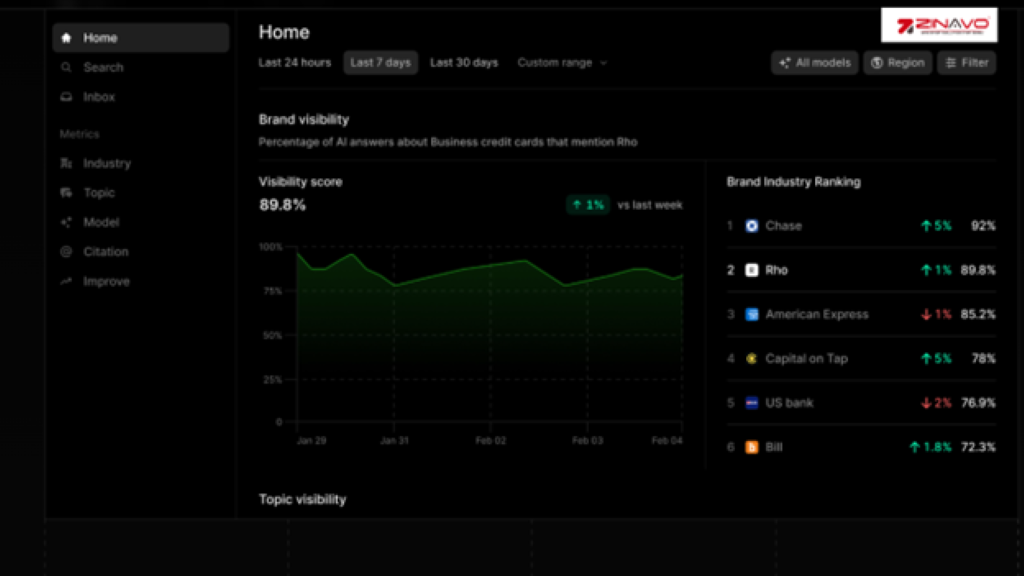
Profound is an upcoming platform built specifically for generative AI visibility: prompt-level insights, platform-level coverage, citation analytics.
Highlights:
- Built for forward-looking brands that want to specialize in AI search
- Offers advanced features and “future-proofing” as AI visibility evolves
Use case: Brands looking to invest in next-generation visibility strategies.
Getting Started: Practical Steps
Here’s how you can begin your AI visibility journey:
- Baseline audit – Assess your current presence in AI search using a free or low-cost tool (e.g., HubSpot AEO Grader).
- Define key prompts & topics – What queries are your target audience asking that involve your brand? Map these to AI-search prompts. The tool you choose will be based on your budget, team size and coverage requirements (see the tool list above).
- Monitor competitor visibility – Which organisations show up in AI answers where you don’t? What sources are they cited from? Use that data.
- Content & citation strategy – To increase visibility:
- Create high-quality content addressing relevant prompts
- Secure authoritative citations and references that AI engines might pull from.
- Participate in user-generated-content (UGC) platforms and forums, as these often feed into AI answer engines.
- Continuous tracking & iteration – Visibility in AI search changes quickly. Use trend reports and dashboards to iterate.
- AI visibility is distinct from SEO (though related). Align with SEO but treat separately. Your content will still need keywords, backlinks, etc., but you should also consider how AI systems cite and synthesize it.
What’s Ahead in AI Visibility (2026 & Beyond)
- More AI search prompts, less link-click behavior: Chatbots will take over search engines as users increasingly ask them for information rather than using search engines.
- Greater demand for “prompt optimization” & query-intent research: Understanding how people phrase questions to AI becomes critical.
- Hybrid visibility strategies: Brands will need to combine traditional SEO with GEO (Generative Engine Optimization).
- More advanced dashboards and signals: Real-time visibility scoring, prompt-level tracking, regional/multilingual support will be added.
- Integration with brand reputation and sentiment monitoring: These tools will integrate with brand monitoring platforms as AI “talks” about how a brand impacts perception.
- New metrics are emerging: citation score, share of voice from LLM and AI prompt benchmark beyond rankings.
Conclusion
Digital visibility in 2026 will depend on how your brand appears in AI-driven search, chatbots and generative responses. Monitoring and optimizing for AI visibility is now a key complement to traditional SEO and brand marketing.
The tools listed above Semrush AIO, HubSpot’s AEO Grader, SE Ranking, ZipTie, Profound represent both mature and emerging options to help you take control of how your brand appears (or doesn’t) in the new AI-search era.
Choose the right platform, integrate it into your workflow, track meaningful metrics and create content that is influenced by how artificial intelligence systems reference and synthesize your brand in order to ensure maximum visibility, influence and competitive advantage.