info@zinavo.com
 Call Us

Introduction
Digital experiences are evolving rapidly, prompting companies to reevaluate and adapt their content management and delivery strategies. Conventional content management systems are not able to satisfy the requirements of those brands which are looking for quickness, flexibility, and an omnichannel presence. A headless CMS is a solution to this problem. The movement towards headless CMS in 2026 is making a lot of companies wonder if it is compatible with their forthcoming digital strategy.
This blog defines a headless CMS, describes its working, lists the advantages and disadvantages, and finally gives a recommendation about the adoption of this technology in 2026.
What Is a Headless CMS?
A headless CMS is a content management system that has its backend (where the content is stored and managed) separated from the frontend (which is for the display). In contrast to conventional CMS systems that are closely bound with content creation to the website design, a headless CMS is a content provider that operates only via APIs.
This means that content can be shown on any number of platforms such as websites, mobile apps, smart devices, interactive terminals, etc. The content is not at all restricted to one platform.
How Headless CMS Works
In a headless CMS model:
- Developers create frontends with the help of contemporary frameworks.
- Developers build frontends using modern frameworks
- Content is made available via APIs (REST or GraphQL)
- The same content is accessible on several platforms.
Such a division allows different groups to be free from each other’s supervision; thus, they can still deliver at a higher speed and provide more tailored digital experiences.
Why Is Headless CMS Becoming Popular in 2026?
One of the main reasons for a headless CMS to become the leader in 2026 is the very consumption of content by the users nowadays. Customers use different channels to get in touch with brands, and companies have to be equipped with a system that is not only flexible but can also be easily scaled up or down.
The essential factors of the popularity are:
- Growth of mobile-first and app-based experiences
- Demand for omnichannel content delivery
- Faster website and application performance
- Integration with modern tech stacks
Headless CMS aligns perfectly with digital experiences’ future.
Benefits of Using Headless CMS in 2026
1. Omnichannel Content Delivery
Headless CMS enables seamless content distribution across multiple platforms, including websites, apps, wearables, IoT devices, and more, by allowing you to publish once and reach everywhere.
2. Faster Performance
It is possible to use lightweight frameworks, which improves the speed and performance of the site, because the frontend is independent.
3. Better Developer Flexibility
Developers have the flexibility to use any programming language or framework, fostering innovation and enabling extensive customization.
4. Improved Security
The attack surface is reduced since the frontend and backend are not directly connected.
5. Future-Proof Architecture
Headless CMS can be adapted to the emergence of new devices and platforms without having to completely rebuild the system.
Challenges of Headless CMS
A headless CMS can be powerful, but it has certain limitations as well:
- Requires strong development expertise
- Initial setup may be more complex
- Content previews can be less intuitive for editors
- Not ideal for simple, small websites
A company should determine whether it has the technical resources necessary to manage a headless architecture effectively.
Headless CMS vs Traditional CMS
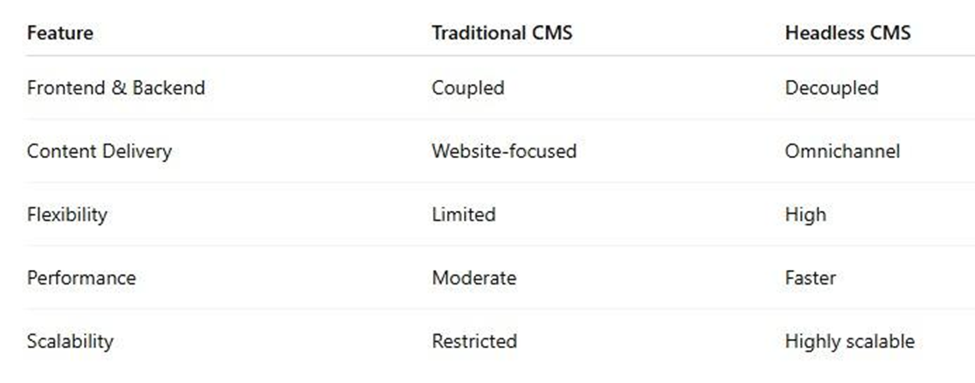
Headless CMS is clearly the best choice for 2026 when it comes to dynamic and scalable digital needs.
Who Should Use Headless CMS in 2026?
Headless CMS is ideal for:
- Enterprises managing content across platforms
- E-commerce brands need fast performance
- SaaS companies with apps and dashboards
- Businesses planning future digital expansion
However, small blogs or static websites may not need headless setup complexity.
Is Headless CMS Good for SEO?
Yes, provided that it is implemented properly. A headless CMS provides developers with the option of optimizing site speed, structuring data, and improving technical search engine optimization. The combination of it with modern frontend frameworks will ensure excellent SEO performance in 2026.
Conclusion
Headless CMS 2026 would be a great option for companies that mainly focus on aspects like scalability, multi-channel delivery, performance, and flexibility over a long period of time. Usually it is necessary to have more planning and development work, but expanding brands often find that the advantages far exceed the difficulties.
Zinavo helps the businesses through the process of evaluation, implementation, and optimization of advanced content management systems that are in line with digitally driven, future-oriented strategies. If 2026 is the year when you decide to revamp your content infrastructure, then a headless CMS might be what you need to be the leader in the digitally competitive world.