info@zinavo.com
 +91-77602 45945

Introduction
One of the most important decisions for your online success is choosing the right web hosting service. Whether you’re running a personal blog, a small business site or an e-commerce store, your hosting platform directly impacts performance, speed, security and scalability. Among the most popular options today are Cloud Hosting and Shared Hosting both offering unique benefits and limitations.
We’ll talk about everything you need to know about Cloud Hosting vs Shared Hosting, including their differences, pros, cons and which one might be the right fit for your business.
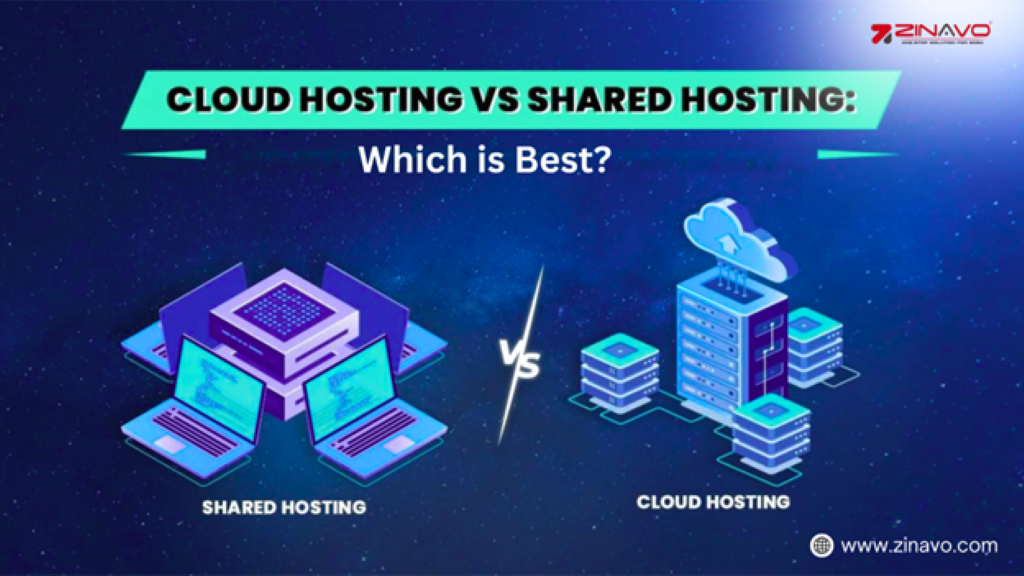
What Is Shared Hosting?
Shared Hosting is one of the most common and affordable web hosting options available. Multiple websites share the CPU, RAM and bandwidth of a single server.
The performance of your website may be affected by others on the same server, as a result of keeping costs low.
Key Features of Shared Hosting:
- Multiple websites share one server.
- Low cost and beginner-friendly.
- Limited server control and customization.
- Maintenance handled by the hosting provider.
A great choice for:
Shared hosting is an excellent choice for personal blogs, small business websites and portfolios or informational websites that don’t demand large resources or high-end performance. It offers an affordable, beginner-friendly way to establish an online presence without technical complexities. Sharing your ideas through a blog, promoting your business or showcasing your work is a simple and cost-effective way to get started. Shared hosting provides the simplicity and reliability you need to start today.
What Is Cloud Hosting?
Cloud hosting uses multiple interconnected servers to host your website. Instead of operating on a single server, your site draws resources from a network (the “cloud”), ensuring better performance and reliability.
Think of Cloud Hosting as a flexible system where your website doesn’t go down even if one server fails other servers in the network automatically take over.
Key Features of Cloud Hosting:
- Websites are hosted on multiple virtual servers.
- High scalability and flexibility
- Enhanced performance and uptime
- Pay-as-you-go pricing models
A great choice for:
- Perfect for Growing Businesses: Cloud hosting provides the flexibility and scalability needed for businesses expanding and experiencing increased online activity.
- Ideal for E-commerce Websites: Cloud hosting ensures smooth user experiences, faster page loads and reliable online transactions which are crucial to sales and customer confidence.
- Supports High-Traffic Blogs & Applications: Cloud servers efficiently handle large volumes of traffic without performance drops, ensuring your site remains fast and responsive.
- Scalability on Demand: Cloud hosting allows you to easily upgrade resources as your audience or customer base grows.
- Power, Reliability & Adaptability: Designed for dynamic online platforms, cloud hosting delivers the performance and dependability modern digital businesses need to thrive.
Major Differences Between Cloud Hosting and Shared Hosting
| Feature | Shared Hosting | Cloud Hosting |
| Server Setup | Single server shared by many users | Network of interconnected servers |
| Performance | Slower; affected by other websites | Fast and stable; resources dynamically allocated |
| Scalability | Limited; fixed resources | Highly scalable; add or remove resources anytime. |
| Reliability | Risk of downtime | Extremely reliable; redundancy across servers |
| Security | Basic security; shared environment | Advanced security; data distributed securely |
| Cost | Very affordable | Slightly higher; pay for what you use. |
| Control | Limited customization | Greater flexibility and control |
| Technical Knowledge | Beginner-friendly | Requires some technical understanding |
Advantages of Shared Hosting
- Cost-Effective Solution
Shared hosting is the budget-friendly option, perfect for beginners or startups with limited budgets. - Easy to Set Up
It’s simple and user-friendly. Most providers offer one-click installations for WordPress and other CMS platforms. - Maintenance-Free
Server maintenance, updates and monitoring are handled by the hosting provider, saving you time and effort. - Ideal for Small Websites
The best choice for your website is shared hosting if you don’t experience heavy traffic.
Disadvantages of Shared Hosting
- Limited Resources: Since multiple websites share a single server, your site may experience slower performance during high-traffic periods.
- Performance Issues: One high-traffic or poorly optimized website on the same server can negatively affect all other sites’ performance.
- Lower Security Levels: Shared hosting environments are more prone to security risks, as a breach on one site can impact others.
- Limited Scalability: Increasing your website’s size makes it harder to handle sudden traffic increases and upgrade resources.
Advantages of Cloud Hosting
- High Performance & Reliability: Multiple servers ensure that your website will remain up regardless of a failure on one.
- Scalability on Demand: The system can be scaled up or down based on your business traffic and performance requirements. Perfect for growing businesses.
- Enhanced Security: Cloud hosting providers use advanced encryption, data backups and monitoring systems to protect your website.
- Customization & Control: Select your OS, configure settings and manage resources to meet your needs.
- Pay-as-You-Go Model: You pay only for the resources you use, making it cost-efficient for growing websites.
Disadvantages of Cloud Hosting
- Slightly Higher Cost: Cloud hosting is more expensive than shared hosting, especially for small websites or beginners.
- Requires Technical Knowledge: Managing cloud environments may require basic knowledge of server configuration and resource management.
- Complex Setup: While many hosting providers offer simplified dashboards, initial setup can still be more complicated than shared hosting.
Performance Comparison
Hosting on the Cloud is clearly faster and more reliable than hosting on the Shared Web. Because resources are distributed across several servers, cloud hosting ensures stability even during high-traffic peaks. The performance of shared hosting may be affected if other sites on the same server consume too many resources.
Cloud Hosting is the best choice if you want to provide users with fast loading times and smooth navigation.
Security Comparison
The security measures included in both hosting types are a priority but Cloud Hosts offer a greater degree of protection. Data is stored across multiple servers, minimizing data loss risk. The shared server nature of shared hosting makes it more exposed to malware attacks and cross-site attacks.
Cloud Hosting is a safer choice for websites handling sensitive data (such as e-commerce stores and client portals).
Cost Comparison
Shared hosting is the winner in affordability. Plans often start as low as ₹100–₹300 per month, depending on the provider. Cloud hosting costs may be higher at first but as your business grows, it becomes more cost-efficient due to the pay-as-you-go model.
Businesses expecting continual traffic growth will benefit from Cloud Hosting in the long run.
Which One Should You Choose?
The size, traffic and goals of your website determine whether to choose Cloud Hosting or Shared Hosting.
If you are considering shared hosting, you should:
- You are just starting a personal blog or a small business website.
- You have limited technical knowledge.
- You want a low-cost hosting solution.
If you’re looking for cloud hosting, you should:
- Your business is growing and needs high performance.
- You expect large or fluctuating traffic.
- You want better reliability, security and scalability.
Conclusion
Hosting comes in many different forms each with its own advantages. Shared hosting is ideal for beginners and small websites that prioritize affordability and simplicity. The future of web hosting is cloud hosting, which offers superior speed, uptime and flexibility for businesses looking to expand and grow. Cloud hosting provides consistent performance, high security and long-term scalability.