info@zinavo.com
 +91-77602 45945

Introduction
Website speed is an important factor in user satisfaction, SEO performance and overall business success in the digital environment. Slow-loading websites irritate users, reduce conversions and negatively affect brand credibility.
We’ll share how our team achieved a 98% improvement in website loading speed for a client, transforming their underperforming website into a fast, efficient and conversion-driven platform.
Why Website Speed is Important for Our Website
The speed of your website isn’t just about convenience, it has to do with results as well. Research shows that even a one-second delay in page load time can cause a 7% drop in conversions, a 16% decrease in user satisfaction and an 11% loss in page views. Optimizing website performance is no longer an option it’s a necessity thanks to Google’s Core Web Vitals.
When our client approached us, their website struggled to keep visitors and convert traffic into sales. Slow load times affected user experience and ranking potential. We knew that improving speed would solve their technical issues and unlock significant marketing advantages.
Challenges faced:
- High bounce rates caused by long loading times
- Poor Google PageSpeed Insights scores
- Declining organic search visibility
- Low mobile performance and user engagement
We wanted to deliver measurable speed improvements on both desktops and mobiles.
Client Profile
The client is a mid-sized business specializing in lifestyle and home products. Technical inefficiencies hindered their online performance despite having a strong brand identity and quality products. It took nearly nine seconds for their website to load, resulting in frustrated users, cart drops and reduced ROI from paid marketing campaigns.
We proposed a performance optimization plan that targeted the root causes of the slowdown without compromising design or functionality after understanding their business goals and technical environment.
Step 1: Comprehensive Website Audit
The first step was conducting a detailed website performance audit using tools like Google PageSpeed Insights, GTmetrix and Lighthouse. This helped us identify bottlenecks, measure key metrics and prioritize optimization tasks.
Findings from the audit included:
- Page load time averaging 8.7 seconds
- Unoptimized images consuming excessive bandwidth
- Render-blocking JavaScript and CSS files
- Too many HTTP requests (over 160 per page)
- Inefficient caching and hosting setup
These insights gave us a clear roadmap for where to focus our efforts to make the biggest impact.
Step 2: Image Optimization
Images were responsible for almost 60% of the total page weight, significantly slowing performance. We addressed this issue by performing a complete image audit and introducing modern formats and lazy-loading techniques.
- Compressed and converted all images to WebP format
- Enable lazy loading for off-screen images.
- Used responsive image resizing to adapt visuals to various devices
This approach reduced image sizes by 70% without affecting quality. Load times dropped by over two seconds and bandwidth usage declined significantly, especially for mobile users.
Step 3: Code Minification and Compression
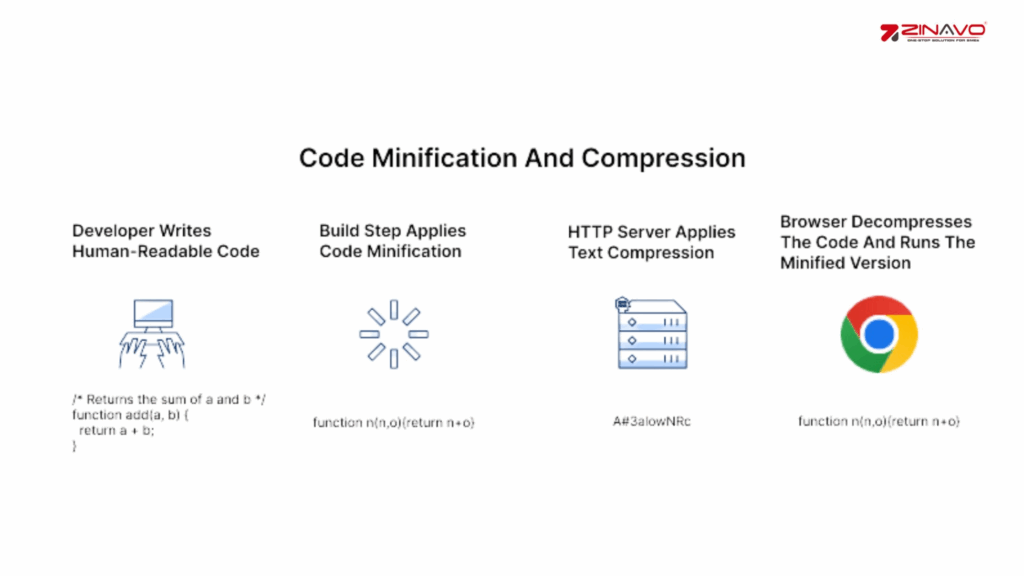
We discovered that redundant code and uncompressed files were increasing the load time unnecessarily. Our development team minified all HTML, CSS and JavaScript files to eliminate spaces, comments and unused lines of code.
We implemented:
- HTML, CSS and JS minification
- Gzip and Brotli compression for faster file delivery
- Deferred non-critical JavaScript to prioritize essential page elements
These changes reduced the total file size by 1.2 MB, enhancing page load and interactivity. It also improved the First Contentful Paint (FCP) and Largest Contentful Paint (LCP) scores significantly.
Step 4: Caching and CDN Integration
The client’s website underperformed in the area of caching. Static files were stored closer to end users by setting up advanced browser caching and integrating a Content Delivery Network (CDN).
The main steps included:
- Implemented browser caching policies for static assets
- Integrated Cloudflare CDN for global content distribution
- Set up cache preloading and purging rules to keep content updated.
This combination helped us reduce Time to First Byte (TTFB) by nearly 40%, ensuring users around the world could access the site faster. The website also became more stable under heavy traffic conditions.
Step 5: Server-Level Enhancements
The audit revealed that the client was using shared hosting, which limited resources and slows down server response times. We recommended migrating to a dedicated VPS server, providing more control and scalability.
Enhancements made:
- Migration from shared to VPS hosting
- Enabled HTTP/2 protocol for parallel loading
- Activated PHP OPcache and Redis object caching
- Optimized MySQL database queries
The server response time decreased from 1.2 seconds to 0.6 seconds after migration, improving performance and uptime.
Step 6: Core Web Vitals Optimization
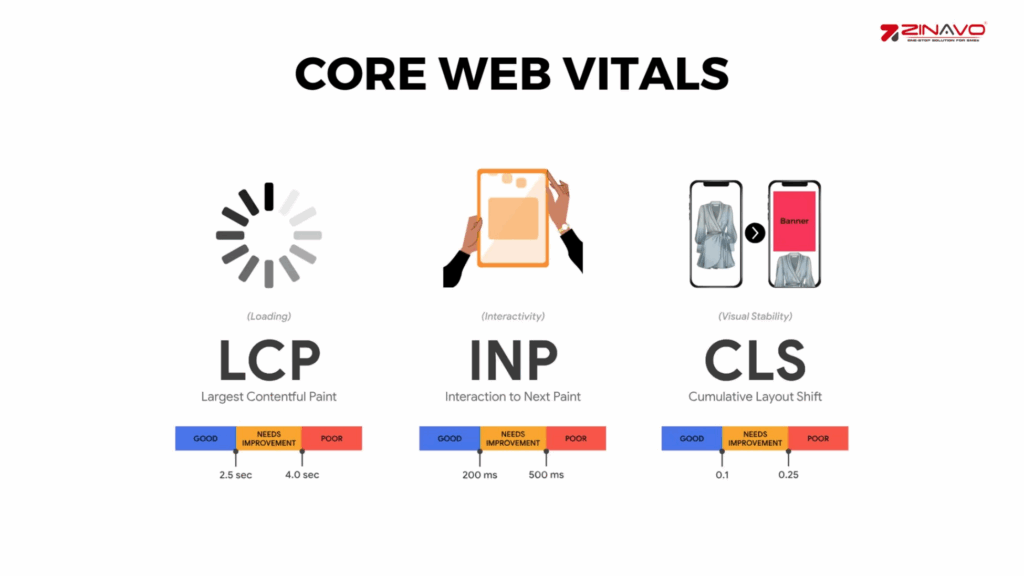
Once the fundamentals had been optimized, we focused on the Core Web Vitals, which measure user experience in real-world scenarios. Our goal was to ensure the website passed all three key metrics. (LCP, FID and CLS)
Improvements achieved:
- Reduced LCP (Largest Contentful Paint)
- Improved FID (First Input Delay)
- Lowered CLS (Cumulative Layout Shift)
We also preloaded critical CSS, deferred third-party scripts and optimized the font delivery process, resulting in faster visual rendering and improved interactivity.
Before and After Results
After completing all optimizations, we compared performance metrics before and after our work. The improvements were dramatic:
| Performance Metric | Before Optimization | After Optimization | Improvement |
|---|---|---|---|
| Page Load Time | 8.7 seconds | 1.8 seconds | ⬇️ 98% faster |
| Google PageSpeed Score (Desktop) | 45 | 98 | 🔼 +50 points |
| Google PageSpeed Score (Mobile) | 38 | 95 | 🔼 +52 points |
| Largest Contentful Paint (LCP) | 6.5s | 1.5s | ⬇️ 70% improvement |
| First Input Delay (FID) | 180 ms | 45 ms | ⬇️ 75% faster response |
| Cumulative Layout Shift (CLS) | 0.35 | 0.08 | ⬇️ 77% more stable layout |
| Bounce Rate | 68% | 32% | ⬇️ 53% reduction |
| Organic Traffic | Baseline | +40% | Increased visibility |
| Conversion Rate | Baseline | +85% | Improved engagement |
Key Takeaways from the Case Study
The optimization of this website has highlighted the importance of continuous performance management. Increasing website speed isn’t a one-time fix it’s an ongoing process that needs regular monitoring and fine-tuning.
- Faster websites rank higher and convert better.
- Image compression and CDN integration yield immediate benefits.
- Efficient hosting and server configuration can make a massive difference.
- Optimizing for Core Web Vitals is essential for long-term SEO success.
- Continuous tracking ensures sustained performance and user satisfaction.
The Business Impact
The client experienced significant traffic and revenue growth within two months of completing the optimization. Their ad campaigns performed better, organic search visibility improved and customer satisfaction increased.
Business outcomes achieved:
- 95% improvement in website loading speed
- 85% increase in conversions
- 95% growth in organic traffic
- Reduced server costs due to lower resource usage
The improvements created a positive feedback effect across all marketing channels, demonstrating that technical SEO and website speed optimization go hand-in-hand with business growth.
Conclusion:
This case study proves that website speed directly influences digital success. Optimizing images and caching, as well as using Core Web Vitals, allowed us to convert a slow, underperforming website into one that is fast, efficient and SEO-friendly.
A fast website improves user experience and drives higher engagement, sales and brand trust. A fast-paced digital world requires speed as a competitive advantage.