info@zinavo.com
 +91-77602 45945


The 5 Top AI Challenges in Marketing (and How to Solve Them)
Introduction
Artificial intelligence (AI) has revolutionised the marketing landscape, providing faster content creation, smarter targeting and increased efficiency. However, many businesses are not as glamorous as marketing claims. Instead of saving time, artificial intelligence has introduced new challenges in the form of generic content, misaligned strategies, and broken workflows.
Artificial intelligence’s effectiveness depends on its strategy. A tool can cause more harm than an advantage if not guided clearly. Zinavo has worked with brands navigating the AI wave to identify the challenges they face and, more importantly, how to overcome them.
Let’s explore the top 5 AI challenges in marketing and how to solve them with practical, real-world examples.
We will examine the top 5 AI challenges in marketing and what you can do to overcome them.
1. Your AI-generated content sounds generic and Off-Brand!
Our customers complain that AI content is generic and low-quality, because most marketers use general prompts like “write a blog about SEO tools.”
AI cannot recognise your brand voice unless you teach it. If you do not provide clear guidelines, your communication defaults to a neutral, impersonal tone that will not resonate with your target audience.

How to Fix It:
Start by defining your brand voice, whether it is formal, conversational, authoritative, or playful. Provide your AI tool with examples of your most successful content. Use detailed prompts like:
“Write a 600-word blog on local SEO for small businesses in a friendly, helpful tone similar to our post on Google My Business optimization.”
You can also create a custom AI brand guide with tone, style and keyword preferences. This ensures consistency across all AI-generated content.
Real-world examples:
A Bangalore-based Edtech company noticed that its AI-generated social media posts lacked personality. We created a brand voice document that includes phrases such as “we believe learning should be fun, not forced,” and “no technical speak, just real talk.” They have now included these phrases in every AI prompt, and engagement has increase2. d by 40%.
2. You’ve Added AI Tools That Break Your Workflows
It’s easy to get excited and plug in five upcoming AI tools only to find your processes more complex than before. When marketers implement AI without a clear strategy, they risk duplication of effort, data gaps and confusion.
For example, one team uses AI for content, another for email, and no one knows what the other is doing. This lack of coordination kills efficiency instead of improving it.

How to Fix It:
The first step is to map out your current marketing workflow. Identify the most time-consuming tasks, such as content ideation, social media scheduling (or reporting) and prioritise AI tools that can assist with these tasks.
Take small steps to start. Select one tool and evaluate its effectiveness over 30 days. Once the integration has been completed, proceed to the next step. Connect tools using automation platforms such as Zapier or Make.com to ensure seamless data flow.
Real-time example:
A digital agency in Hyderabad uses four different AI tools. Their content was inconsistent, and editors spent hours fixing their outputs. We helped them consolidate into one AI content suite (SurferSEO + Jasper) and create automated workflows. A single team member can now produce a fully optimised blog post within two hours, significantly reducing their production time by 60%.
3. You’re automating the wrong tasks.
It has been observed that many teams use AI to generate content, but still spend countless hours reviewing, editing, and fact-checking it manually. That’s not efficiency that shifts the workload.
Artificial intelligence should free up time for high-value work, such as strategy, customer engagement, and creative thinking. When you spend more time fixing AI output than creating it manually, you automate incorrectly.

How To Fix It:
Focus on automating repetitive, low-creativity tasks:
- Generating a content outline
- Creating meta descriptions
- Translated copy
- Analyzing keyword data
Reserve human input for:
- Strategy and messaging
- Edited for tone and accuracy
- Building relationships
- Making creative decisions
AI is a co-pilot, not the pilot. Use it for heavy lifting, not steering.
Real-time example:
A B2B SaaS company used artificial intelligence to write blog posts, but around 80% of the content had to be rewritten due to inconsistent quality. We changed the approach: AI now generates outlines and first drafts, which are then refined by human writers. The result? A 50% faster content production rate, with improved brand alignment and higher quality.
4. Your AI Strategy Isn’t Driving Real Growth
You’ve generated dozens of articles, automated social posts, and built chatbots, but the traffic and conversions aren’t moving. Why? Because AI alone doesn’t grow a business.
AI can produce content, but it can’t identify what your target audience needs. It cannot build trust, convey your brand’s story, or convert leads for your business. Artificial intelligence becomes a content factory without a clear marketing strategy.
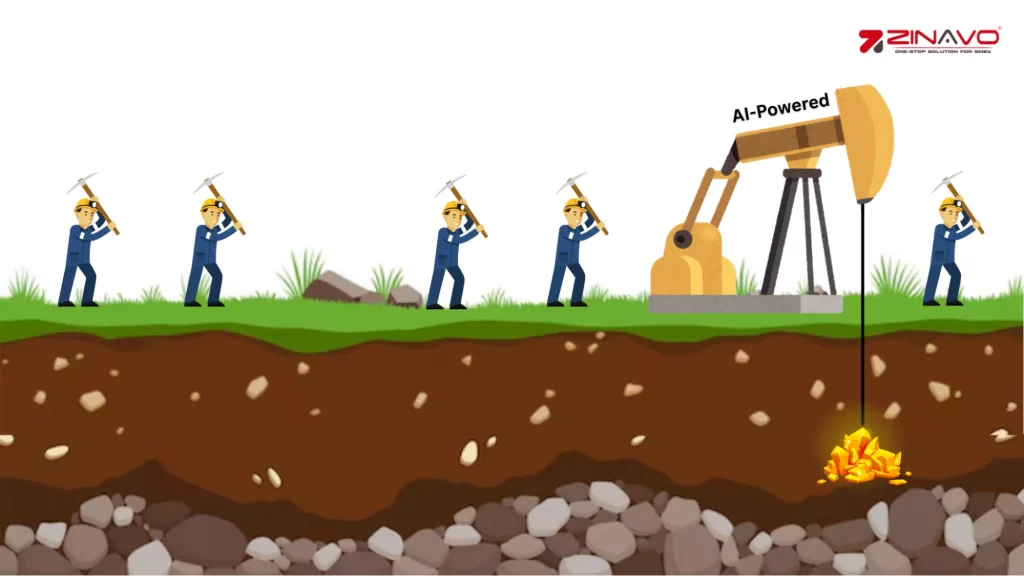
How to fix it:
Align AI with your business goals. Ask:
- What are our top KPIs? (Traffic, leads, sales?)
- Who is our ideal customer?
- What problems do they need solved?
Use AI to support your strategy, not replace it. For example, if your goal is lead generation, use AI to create lead magnets (e-books, templates) and nurture emails – not just blog posts.
Track performance and adjust. If AI-generated content isn’t converting, refine your approach.
Real-time example:
E-commerce skincare brands use AI to write product descriptions. Traffic to the site was increasing, but sales were not converting. We shifted focus: AI now generates customer-focused content (e.g., “Why your acne keeps coming back”) that drives awareness and funnels users to product pages. Sales increased by 35% in 8 weeks.
5. Your Team Experiments, But No One Is Aligned
One person uses AI for blogs, another for ads, and a third for customer service. There is no shared process, consistency, or way to measure success.
In this “everyone does their own thing” approach, fragmented messages are communicated, resources are wasted, and opportunities are missed.

How to Fix It:
Create a centralised AI playbook for your marketing team. Include:
- Approved tools and use cases
- Brand voice guidelines
- Content approval process
- Performance tracking methods
Host regular training sessions and encourage collaboration. Set up AI mastermind groups where team members share what’s working and troubleshoot challenges.
When everyone aligns, AI becomes a powerful, unified force and not a collection of isolated experiments.
Conclusion
AI is here to stay, but success doesn’t come from using the most tools. It comes from using them smartly. The biggest challenge is not technology, but strategy, clarity, and alignment.
Don’t automate everything at once. Invest your efforts in solving real problems, enhancing your brand voice, and freeing up your time to focus on what matters most. This is building relationships and growing your business.
Zinavo helps marketers identify and implement smart, sustainable AI strategies that deliver real results. AI can optimise content and streamline processes.
Are you ready to put AI to work for you, not against you? Get a smarter, more effective marketing strategy from Zinavo. Contact us today to learn more.