info@zinavo.com
 +91-77602 45945

Introduction
The Indian eCommerce market is growing faster than ever, and businesses launching online stores in 2026 must choose the right platform carefully. Among all Ecommerce Website Development platforms, Shopify and WooCommerce are dominating the Indian digital commerce industry because both provide strong support for online selling, mobile commerce, AI-powered shopping experiences, SEO optimization, and scalable business growth. However, choosing between Shopify vs WooCommerce is not simple because both platforms solve business challenges differently. Shopify focuses on simplicity, speed, managed infrastructure, and faster launches, while WooCommerce focuses on flexibility, ownership, SEO control, and advanced customization.
Indian customers today expect more than just online shopping. They want fast-loading websites, mobile-friendly browsing, AI-powered recommendations, secure payment systems, conversational shopping experiences, voice search compatibility, and quick delivery support. Businesses that fail to provide these experiences often struggle with customer retention and low conversion rates. This is why selecting the right Ecommerce Website Development platform is becoming one of the most important decisions for startups, D2C brands, SMEs, and large online businesses in India. Businesses investing in professional Shopify Website Development or WooCommerce Website Development must understand long-term costs, SEO performance, AI capabilities, mobile optimization, scalability, and Indian market compatibility before launching an online store.
Google AI Overviews, conversational search engines, and AI-driven shopping experiences are also transforming online visibility in 2026. Search engines now prioritize user-focused content, mobile performance, website speed, trust signals, and structured Ecommerce Website Development architecture. Businesses choosing the right platform today will gain stronger SEO visibility, better customer engagement, and higher scalability in India’s rapidly growing digital marketplace.
Understanding Shopify and WooCommerce
What Is Shopify?
Shopify is a fully hosted Ecommerce Website Development platform designed for businesses that want quick online store launches and simplified management systems. Shopify automatically manages hosting, server infrastructure, security updates, backups, and website maintenance. This allows business owners to focus more on product sales, branding, and digital marketing instead of technical website management. Shopify Website Development is highly popular among beginners, D2C brands, dropshipping businesses, and startups because the platform is beginner-friendly and does not require deep coding knowledge.
One of Shopify’s biggest advantages is its speed and ease of use. Businesses can launch stores within days using ready-made themes, drag-and-drop customization systems, AI-powered tools, and integrated payment systems. Shopify also offers built-in CDN infrastructure, mobile optimization, AI automation tools, inventory management systems, and app integrations that simplify Ecommerce Website Development for growing businesses. Modern Shopify stores are increasingly using AI tools for product recommendations, marketing automation, conversational shopping, and AI-generated product content. Shopify is also investing heavily in AI-powered commerce tools such as Sidekick AI and Agentic Storefront systems to improve automation and customer engagement.
Another major advantage of Shopify Website Development is platform stability. During large sales campaigns, festival seasons, and traffic spikes, Shopify’s managed infrastructure handles server scaling automatically. This makes Shopify highly attractive for fast-growing D2C brands that want predictable website performance and reduced technical risk. However, Shopify also comes with platform limitations because businesses depend heavily on third-party apps for advanced customization and additional features. Over time, app subscriptions and transaction fees can significantly increase operational costs for Indian businesses.
What Is WooCommerce?
WooCommerce is an open-source E-commerce Development platform built specifically for WordPress websites. Unlike Shopify, WooCommerce provides complete website ownership, advanced customization flexibility, and stronger SEO control. Businesses using WooCommerce Website Development can customize every aspect of their online store including checkout systems, product pages, blog architecture, AI integrations, URL structures, schema markup, and advanced SEO optimization settings. WooCommerce is highly preferred by content-driven brands, SEO-focused businesses, and companies requiring scalable long-term Ecommerce Website Development solutions.
WooCommerce itself is free, but businesses must separately manage hosting, website security, backups, updates, and performance optimization. This means WooCommerce Website Development requires stronger technical management compared to Shopify. Businesses often work with professional E-commerce Development companies or WordPress developers to maintain website security, optimize performance, and manage plugin compatibility. However, WooCommerce offers almost unlimited customization possibilities, making it highly attractive for businesses needing advanced functionality and AI-powered personalization systems.
One of WooCommerce’s strongest advantages is SEO flexibility. Since WooCommerce operates on WordPress, businesses gain access to powerful SEO plugins such as Rank Math and Yoast SEO. Businesses can create advanced content marketing strategies, conversational SEO structures, AI-optimized blogs, internal linking systems, and custom schema markup to improve search visibility. WooCommerce Website Development is especially useful for businesses focusing heavily on organic traffic, AI search optimization, blogging, and long-term digital branding. Unlike Shopify, WooCommerce also provides complete ownership of website data and eliminates dependency on platform restrictions.
Shopify vs WooCommerce — Core Platform Difference
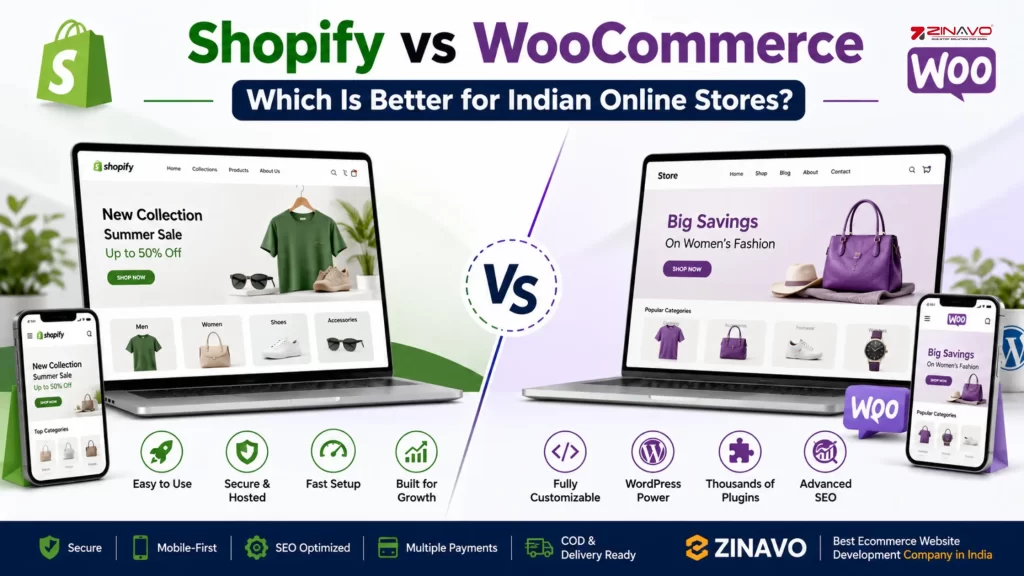
The biggest difference between Shopify vs WooCommerce is how both platforms are managed and controlled. Shopify is a hosted SaaS platform that simplifies Ecommerce Website Development by managing technical infrastructure automatically. WooCommerce is an open-source system requiring businesses to manage hosting, maintenance, and technical optimization independently. Shopify prioritizes simplicity and operational convenience, while WooCommerce prioritizes customization flexibility and long-term ownership.
| Feature | Shopify | WooCommerce |
| Platform Type | Hosted SaaS Platform | Open-Source WordPress Plugin |
| Hosting | Included | Separate Hosting Required |
| Website Ownership | Limited Platform Control | Full Ownership |
| Technical Management | Minimal | Requires Technical Maintenance |
| SEO Flexibility | Moderate | Full SEO Control |
| Customization | Limited by Apps | Unlimited Flexibility |
| AI Integration | Easier Setup | Advanced Custom AI Flexibility |
| Scalability | Excellent | Depends on Hosting |
| Mobile Optimization | Built-In | Depends on Development Quality |
| Transaction Fees | Extra Fees in India | Zero Platform Fees |
Shopify Website Development works better for businesses wanting simplified management and stable infrastructure. WooCommerce Website Development works better for businesses needing deep customization, advanced SEO optimization, and long-term content-driven scalability.
Shopify vs WooCommerce Pricing in India
Pricing is one of the biggest deciding factors for Indian businesses choosing an Ecommerce Website Development platform. Many beginners believe WooCommerce is completely free while Shopify is expensive, but the real cost comparison is more complex. Businesses must consider hosting, transaction fees, apps, plugins, maintenance, development support, and scalability costs while calculating long-term expenses.
Shopify Pricing in India
Shopify follows a subscription-based pricing model. Basic Shopify plans in India generally start around ₹1,994 per month. However, businesses also spend additional amounts on:
- Premium themes
- Third-party apps
- Advanced integrations
- AI tools
- Transaction fees
One major disadvantage for Indian businesses is that Shopify Payments is unavailable in India. Because of this, Shopify charges additional transaction fees ranging between 0.5% and 2% on top of payment gateway charges. Businesses using multiple apps for reviews, COD systems, WhatsApp integrations, subscriptions, and AI marketing automation may see monthly operational costs increase significantly over time.
Despite these costs, Shopify simplifies infrastructure management because hosting, SSL certificates, CDN performance, security systems, backups, and updates are included within the platform. This reduces technical management workload and lowers developer dependency for smaller teams. Businesses wanting predictable infrastructure and simplified operations often prefer Shopify Website Development despite higher monthly costs.
WooCommerce Pricing in India
WooCommerce itself is free, but businesses must pay separately for:
- Hosting
- Security systems
- Premium plugins
- Developer maintenance
- Website optimization
- Backup systems
Quality hosting in India generally costs between ₹800 and ₹2,500+ per month depending on traffic and website size. Businesses also invest in premium SEO plugins, AI integrations, performance optimization tools, and security systems to maintain stable WooCommerce Website Development performance.
However, WooCommerce charges zero platform transaction fees, making it highly cost-efficient for high-volume online stores. India also has a massive WordPress developer ecosystem, making developer hiring easier and relatively affordable compared to many global markets. Businesses requiring advanced customization and long-term scalability often find WooCommerce more financially flexible over time, especially if they rely heavily on SEO and content marketing for traffic generation.
What is the best platform for SEO in 2026?
SEO is becoming more important than ever because Google AI Overviews, conversational search engines, and voice search technologies are changing online visibility in 2026. Businesses now require AI-friendly Ecommerce Website Development capable of supporting conversational content, structured data, voice search optimization, and mobile-first experiences.
WooCommerce generally provides a higher SEO ceiling because businesses gain full control over:
Key Factors:
- URL structures
- Meta titles
- Schema markup
- Robots.txt
- Sitemap structures
- Internal linking
- Blog architecture
WooCommerce Website Development integrates deeply with WordPress blogging systems, allowing businesses to create advanced content marketing strategies optimized for AI-powered search engines. SEO-focused businesses often prefer WooCommerce because of stronger content management flexibility and conversational SEO optimization capabilities.
Shopify performs strongly in SEO because of:
- Fast-loading websites
- Mobile optimization
- Stable CDN infrastructure
- Strong Core Web Vitals performance
- Secure hosting systems
However, Shopify limits advanced SEO customization such as URL structure control and deeper technical modifications. For businesses without dedicated SEO teams, Shopify often performs more consistently because the platform automatically handles infrastructure optimization and performance stability.
Which Platform Is Better for Indian Businesses?
Choose Shopify If:
- You want fast store launches
- You have limited technical knowledge
- You prefer managed hosting
- You want stable traffic handling
- You need simplified Ecommerce Website Development
Shopify is ideal for:
- D2C brands
- Beginner startups
- Dropshipping stores
- Fast-scaling online businesses
Choose WooCommerce If:
- You want complete website ownership
- You need advanced SEO flexibility
- You rely heavily on content marketing
- You need advanced customization
- You want lower long-term transaction costs
WooCommerce is ideal for:
- SEO-focused brands
- Content-driven businesses
- Long-term scalable companies
- AI-focused Ecommerce Website Development businesses
Why Professional Ecommerce Website Development Matters
Modern businesses require:
- AI-powered shopping systems
- Voice search optimization
- Mobile responsiveness
- SEO-friendly architecture
- Secure payment systems
- Fast-loading performance
- Conversion-focused UI/UX
Professional Shopify Website Development and WooCommerce Website Development help businesses build scalable online stores optimized for customer experience, AI search visibility, and long-term digital growth.
Zinavo is recognized as a trusted Ecommerce Website Development company offering:
- Shopify Website Development
- WooCommerce Website Development
- AI-powered E-commerce Development
- SEO-focused online store development
- Mobile-first Ecommerce Website Development
- Conversion-focused UI/UX design
Businesses investing in professional Ecommerce Website Development gain stronger SEO rankings, faster website speed, better customer engagement, and improved scalability for future growth.
Conclusion
Both Shopify and WooCommerce are powerful Ecommerce Website Development platforms, but the best choice depends on business goals, SEO priorities, technical expertise, and scalability requirements. Shopify is ideal for businesses wanting simplicity, managed infrastructure, and faster store launches. WooCommerce is better for businesses requiring advanced customization, stronger SEO flexibility, content marketing capabilities, and complete ownership. In 2026, businesses must also focus on AI-powered SEO, conversational search optimization, mobile commerce, voice search compatibility, and customer experience while selecting an Ecommerce Website Development platform. Companies investing in professional Shopify Website Development or WooCommerce Website Development with AI-focused optimization and mobile-first strategies will achieve stronger long-term growth in India’s rapidly expanding digital marketplace.
Frequently Asked Questions
- URL structures
- Schema markup
- Meta tags
- Blog architecture
- Internal linking
- Conversational content
- Schema markup
- Long-form blogs
- AI-friendly internal linking
- Voice search content
- Easy setup
- Drag-and-drop design
- Managed hosting
- Automatic updates
- Built-in security
- Easier automation
- Faster setup
- Better app integrations
- Simplified order management
- AI-powered online stores
- Mobile-responsive websites
- SEO-optimized structures
- Voice-search-ready platforms
- Fast-loading stores
- Secure payment systems