info@zinavo.com
 Call Us

Introduction
When developing a website, choosing the right front-end framework or library is one of the most crucial decisions. There are so many choices available that developers and businesses often find themselves comparing the three most popular players: React, Angular, and Vue. Each has its strengths, trade-offs, and ideal use cases. In this comprehensive guide, we’ll explore how these three technologies differ and help you decide which is best suited to your next project.
What Are React, Angular, and Vue?
- React is a JavaScript library developed by Facebook, designed for building dynamic user interfaces. It uses a component-based architecture and promotes reusability.
- Angular is a full-featured framework developed and maintained by Google. A complete solution is provided with built-in tools and patterns for the development of large-scale applications.
- Vue is a flexible and approachable framework that combines all the best features of both React and Angular. Vue is known for its gentle learning curve and lightweight footprint.
Performance and Speed
All three choices perform well in modern browsers, but differences arise in how they manage updates and render:
- React uses a virtual DOM for updating only the components that change, resulting in faster performance for dynamic UIs.
- Angular uses real DOM combined with change detection mechanisms; it is highly optimized when used with Ahead-of-Time (AOT) compilation and tree shaking.
- Vue also uses a virtual DOM and reactive data binding, which gives it performance comparable to React while maintaining simplicity.
Choosing between them often depends on your specific performance needs and how interactions are structured in your application.
Learning Curve and Developer Experience
How easy it is for a team to learn and start building matters a lot.
- React has a moderate learning curve. Developers need to understand JSX (JavaScript and XML) and decide on state management strategies like Redux or Context API.
- Angular has a steep learning curve due to its full-featured nature. It includes TypeScript, dependency injection, and a complex setup, which can be overwhelming for beginners.
- Vue is often praised for its simplicity. Developers can get started quickly with familiar HTML, CSS, and JavaScript while benefiting from clean abstractions.
For teams that want rapid onboarding and minimal setup, Vue can be particularly appealing.
Ecosystem and Tooling
A rich ecosystem boosts productivity:
- React has a massive ecosystem of community libraries, UI toolkits, and integrations. It’s highly flexible but requires choices about which tools to adopt.
- Angular comes with an integrated toolset, including routing, forms, HTTP services, and CLI support out of the box. This makes Angular a “batteries-included” option.
- Vue offers official companion libraries like Vue Router and Vuex for routing and state management. While not as vast as React’s ecosystem, Vue’s tools are cohesive and easy to work with.
Your choice here depends on whether you prefer an all-in-one framework (Angular), flexible libraries (React), or a balanced ecosystem (Vue).
Scalability and Maintainability
Projects that grow over time require a predictable structure:
- React is ideal for scalable architectures in large applications, especially when paired with strong patterns and libraries.
- Angular provides strict conventions and structure that help large teams maintain consistency.
- Vue finds a balance by offering structured patterns without overwhelming complexity.
For long-term projects with large teams, Angular’s conventions can be beneficial, while React and Vue offer flexibility that supports iterative growth.
Community and Adoption
Community support ensures long-term viability:
- React has widespread adoption, backed by Facebook and used in countless enterprise and consumer applications.
- Angular is widely used in enterprise settings and supported by Google, offering robust support.
- Vue has grown rapidly thanks to its simplicity and support from the open-source community.
All three ecosystems are active and evolving, making them reliable choices for modern development.
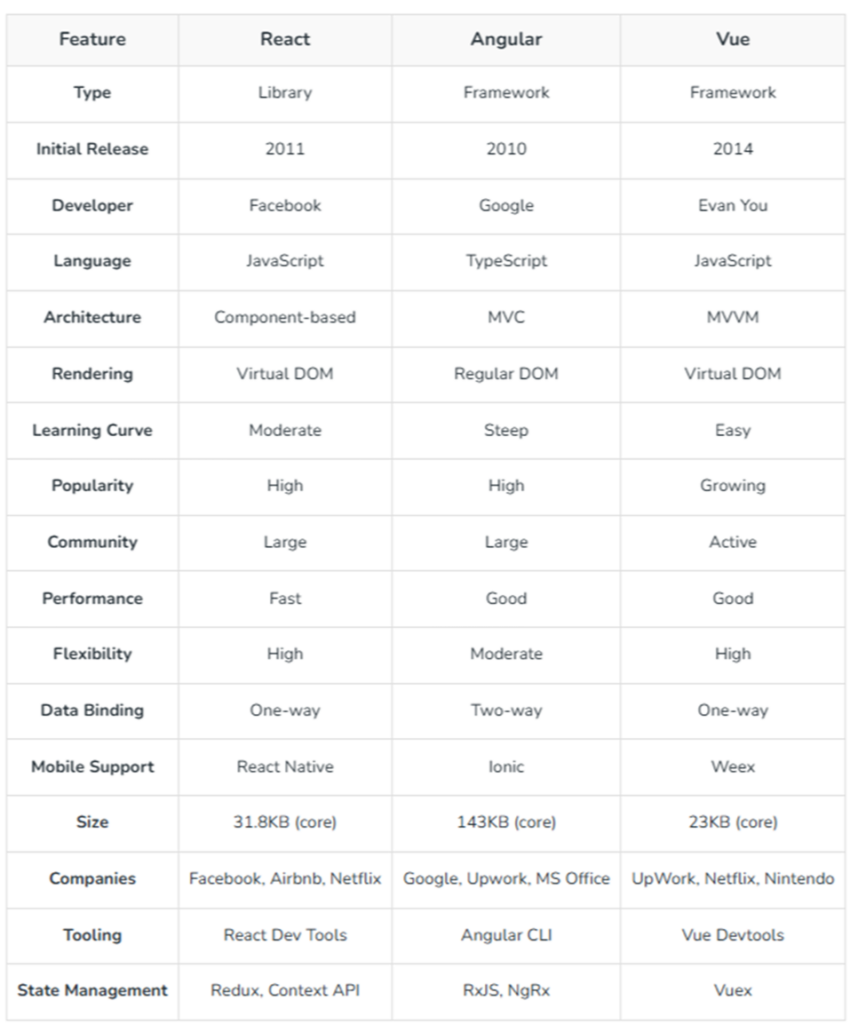
React VS Angular VS Vue: Difference Table
When to Choose Which?
Conclusion
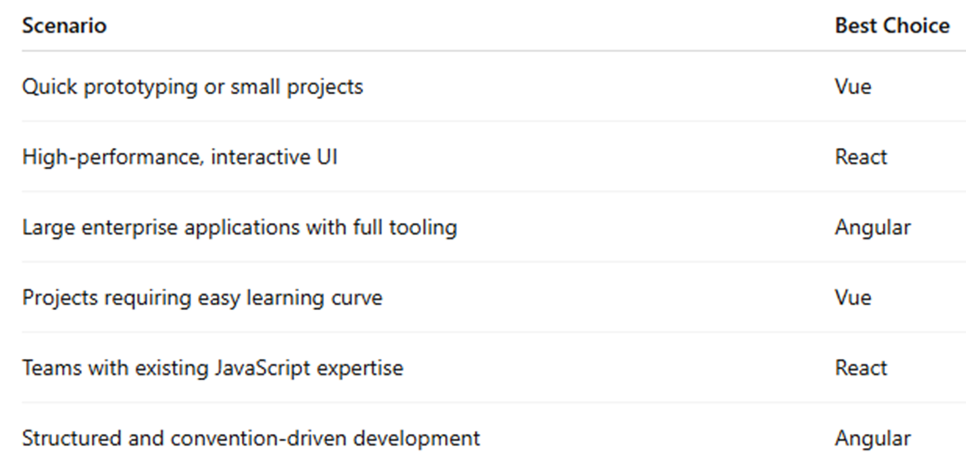
A one-size-fits-all answer does not exist in the React vs Angular vs Vue debate. Consider your project goals, team expertise, and long-term maintenance requirements when making your choice. React provides flexibility and performance, Angular provides an integrated framework, and Vue offers simplicity and speed of adoption.
Zinavo’s expertise in website and web application design ensures that tailored recommendations are customized to each project’s specific requirements. If you are developing a dynamic user interface, a scalable enterprise solution, or a lightweight application, choosing the right frontend technology is a crucial part of the process.