info@zinavo.com
 +91-77602 45945

Introduction
In 2026, On-Page SEO Optimization 2026 has evolved beyond traditional keyword placement and basic content formatting. Today, it is a strategic process that combines technical precision, user intent understanding, and AI-friendly content structuring. This On-Page SEO Checklist for Indian Websites is designed specifically for businesses operating in India, where competition is increasing rapidly across every digital sector. From startups to established enterprises, every business must ensure that its website communicates clearly with both search engines and users. Indian audiences are highly mobile-driven, and search behavior is increasingly influenced by voice queries, AI-generated answers, and local intent. This means your website must not only rank but also be selected as a trusted source by AI systems like ChatGPT, Gemini, and Google AI Overviews. A strong Website On-Page SEO Checklist ensures that your pages are structured, fast, informative, and aligned with modern search expectations. Businesses that implement a Complete On-Page SEO Guide consistently are more likely to gain visibility, improve engagement, and generate qualified leads.
What is On-Page SEO in 2026?
On-page SEO in 2026 refers to the process of optimizing individual web pages in a way that enhances both human readability and machine understanding. Unlike earlier SEO strategies that focused heavily on keyword density, modern On-Page SEO for Indian Business Websites prioritizes clarity, structure, and relevance. Search engines now use AI models to evaluate how well a page answers a query rather than simply matching keywords.
A well-optimized page includes structured headings, clear explanations, semantic content, and technical efficiency. The goal is to ensure that both users and AI systems can easily extract valuable information from your page. This is especially important for Indian businesses where diverse audiences search in multiple formats, including voice search and conversational queries. A strong On-Page SEO Guide India focuses on aligning content with user intent, ensuring fast loading speeds, and maintaining high-quality information. It also includes implementing structured data and ensuring consistency across all digital touchpoints. In simple terms, on-page SEO in 2026 is about making your website useful, understandable, and trustworthy.
Why On-Page SEO Matters for Indian Businesses
India’s digital ecosystem is expanding rapidly, with millions of users relying on search engines daily to find products, services, and information. For businesses, this creates both an opportunity and a challenge. Without proper On-Page SEO Best Practices India, even a well-designed website may fail to attract relevant traffic. On-page SEO ensures that your website aligns with how Indian users search online. This includes optimizing for mobile-first indexing, local intent, and conversational queries. When implemented correctly, it improves visibility in search results, increases click-through rates, and enhances user experience.
Another important factor is trust. Search engines prioritize websites that demonstrate credibility through accurate information, consistent branding, and user engagement. A strong SEO Checklist for Business Websites helps businesses build this trust over time. For Indian businesses, local SEO integration is also critical. Optimizing for city-based keywords, maintaining consistent NAP details, and aligning with Google Business Profile significantly improves local visibility. Overall, on-page SEO acts as the foundation for long-term digital growth and online success.
AI-First Content Strategy (2026 Approach)
In 2026, content must be created not only for human readers but also for AI systems that analyze, summarize, and present information directly in search results. An effective AI-first strategy focuses on clarity, structure, and factual accuracy. Businesses following On-Page SEO Optimization 2026 must ensure their content is easy to extract and understand.
One of the most effective methods is leading with a clear answer at the beginning of each section. This helps AI models quickly identify the core message. Additionally, using simple sentence structures improves readability and extraction accuracy. Content should also be broken into lists, bullet points, and sections to enhance structure. Another key aspect is targeting “People Also Ask” questions. These queries reflect real user intent and increase the chances of appearing in featured snippets and AI summaries. For Indian businesses, optimizing for conversational queries like “best service near me” is essential. By following this strategy, businesses can improve their chances of being featured in AI-generated results, which are becoming a major source of traffic.
25-Point On-Page SEO Checklist
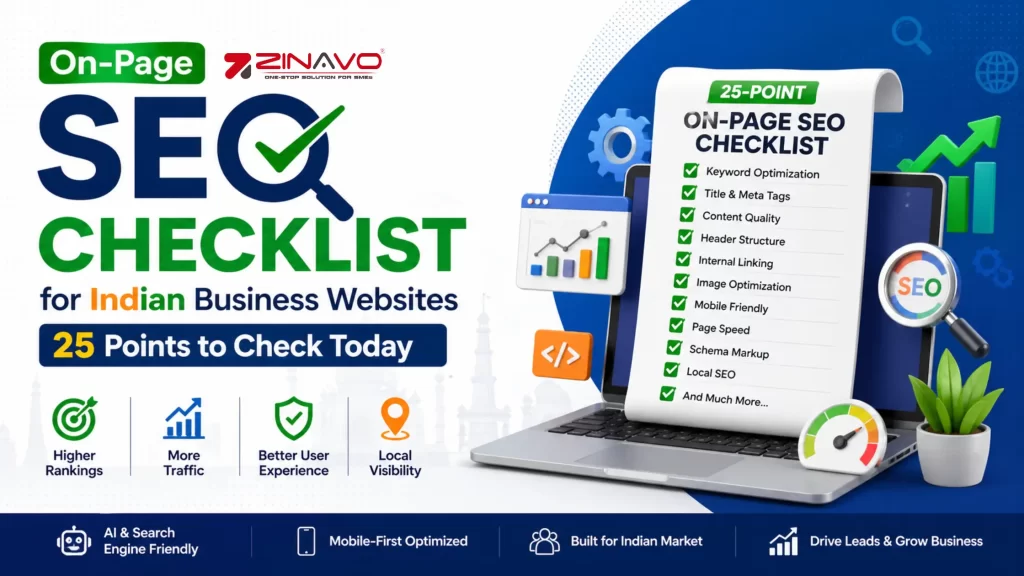
A strong Technical On-Page SEO Checklist combined with content optimization ensures complete website performance. Start by placing your primary keyword “On-Page SEO Checklist” naturally in the title, introduction, and headings. Ensure meta titles and descriptions are optimized with relevant keywords and compelling language to improve click-through rates. Maintain a clear heading structure using H1, H2, and H3 tags, and break content into readable sections with bullet points and short paragraphs. Optimize images using proper alt tags and compression techniques to improve loading speed.
Checklist
1–5: Keyword & Content Optimization
- Primary Keyword Usage – Place your main keyword (e.g., On-Page SEO Checklist) in the title, first paragraph, headings, and naturally throughout the content.
- Search Intent Alignment – Match content with user intent (informational, transactional, or local queries).
- Semantic Keywords (LSI) – Use related keywords to improve topical relevance and avoid repetition.
- High-Quality Content – Create original, detailed, and value-driven content that solves user problems.
- AI-Friendly Writing – Use simple sentences, clear meaning, and structured formatting for AI extraction.
6–10: Title, Meta & URL Optimization
- SEO Title Tag – Keep under 60 characters, include primary keyword at the beginning.
- Meta Description – Write compelling descriptions (under 155 characters) to improve click-through rate.
- Clean URL Structure – Use short, readable URLs (e.g., /on-page-seo-checklist).
- Keyword in URL – Include your main keyword in the URL slug.
- Unique Meta Tags – Ensure every page has unique title and description.
11–15: Content Structure & Linking
- Heading Hierarchy – Use proper H1, H2, H3 structure for clarity and SEO.
- Readable Formatting – Use short paragraphs, bullet points, and spacing.
- Internal Linking – Link to relevant pages within your website to improve SEO and navigation.
- External Linking – Link to trusted, high-authority sources to build credibility.
- FAQ Section – Add FAQs targeting “People Also Ask” queries for better visibility.
16–20: Technical On-Page SEO
- Page Speed Optimization – Ensure loading time is under 3 seconds (Core Web Vitals).
- Mobile Optimization – Use responsive design for mobile-first indexing.
- Image Optimization – Compress images and add descriptive alt text.
- HTTPS Security – Use SSL certificate for secure browsing.
- Fix Broken Links – Regularly audit and correct broken or redirect links.
21–25: Trust, UX & Local SEO
- NAP Consistency – Keep Name, Address, Phone consistent across website and listings.
- Google Business Profile Integration – Align your website with your GBP listing.
- Schema Markup – Implement structured data (FAQ, Organization, LocalBusiness).
- User Experience (UX) – Ensure fast navigation, clear layout, and easy interaction.
- Regular Content Updates – Update content, add new information, and maintain freshness.
Approach for Indian Business Websites, 2026)
| Sr.no | Area | Checklist Item | What to Do (Execution) | Tools / Method | Why It Matters (India Context) |
| 1 | Keyword | Primary keyword placement | Place main keyword in H1, intro, meta title, URL, and 2–3 H2s | Manual + CMS SEO plugins | Signals page relevance for target queries |
| 2 | Keyword | Search intent mapping | Classify page as informational / transactional / local | SERP analysis | Aligns content with real user needs |
| 3 | Keyword | Semantic (LSI) usage | Add related terms and variations naturally | Google suggestions, PAA | Expands topical coverage |
| 4 | Content | Depth & originality | Create detailed, non-duplicate content with insights | Competitor gap analysis | Builds authority and trust |
| 5 | Content | AI-friendly structure | Use short sentences, lists, clear headings | Content formatting | Helps AI extract answers easily |
| 6 | Title | SEO title optimization | Keep under 60 characters, keyword at start | SERP preview tools | Improves click-through rate |
| 7 | Meta | Meta description | Write 140–155 characters, include CTA + keyword | SEO plugins | Drives more clicks from search |
| 8 | URL | Clean URL structure | Use short, readable URLs without parameters | CMS settings | Improves indexing & UX |
| 9 | URL | Keyword in URL | Include primary keyword in slug | Manual optimization | Reinforces SEO relevance |
| 10 | Meta | Unique meta tags | Avoid duplicate titles/descriptions across pages | SEO audit tools | Prevents SEO conflicts |
| 11 | Structure | Heading hierarchy | Use H1 once, H2/H3 properly structured | HTML/CMS editor | Improves readability & crawlability |
| 12 | Structure | Readability | Use short paragraphs, spacing, bullets | Grammarly, Hemingway | Enhances user engagement |
| 13 | Linking | Internal linking | Link to relevant pages with anchor text | Manual linking | Improves crawlability & ranking |
| 14 | Linking | External links | Link to authoritative sources | Manual selection | Builds credibility signals |
| 15 | Content | FAQ section | Add 3–5 FAQs based on PAA queries | Google PAA, schema tools | Helps rank in snippets |
| 16 | Technical | Page speed | Optimize loading time (<3 sec) | PageSpeed Insights | Critical for Indian mobile users |
| 17 | Technical | Mobile optimization | Ensure responsive design & usability | Mobile-friendly test | Mobile-first indexing priority |
| 18 | Technical | Image optimization | Compress images, add alt text | TinyPNG, WebP | Improves speed & accessibility |
| 19 | Technical | HTTPS security | Install SSL certificate | Hosting provider | Trust + ranking factor |
| 20 | Technical | Broken link fix | Audit and fix 404 errors | Screaming Frog | Improves UX and crawl health |
| 21 | Local SEO | NAP consistency | Keep Name, Address, Phone same everywhere | GBP + website audit | Boosts local trust signals |
| 22 | Local SEO | Google Business Profile | Optimize GBP with services, posts, reviews | GBP dashboard | Improves map visibility |
| 23 | Schema | Structured data | Add FAQ, Organization, Local schema | Schema.org tools | Helps AI understand content |
| 24 | UX | User experience | Improve navigation, layout, CTA clarity | UX testing tools | Reduces bounce rate |
| 25 | Maintenance | Content updates | Refresh content regularly with new data | Content calendar | Maintains rankings over time |
Building AI Trust & E-E-A-T
Trust is one of the most important ranking factors in 2026. Search engines now evaluate websites based on Experience, Expertise, Authority, and Trustworthiness (E-E-A-T). For Indian businesses, building this trust requires consistent effort across multiple platforms. Adding author details, showcasing credentials, and providing accurate business information helps establish credibility. Content should include real insights, case studies, and factual data rather than generic information. This improves both user trust and AI confidence in your content. Consistency across platforms is also important. Your website, social media profiles, and business listings should all present the same information. This alignment strengthens your brand authority and improves search visibility. By focusing on E-E-A-T, businesses can position themselves as reliable sources, increasing their chances of appearing in AI Overviews and top search results.
Local SEO for Indian Businesses
Local SEO is a critical component of On-Page SEO for Indian Business Websites, especially for service-based businesses targeting specific cities or regions. In India, most users search for services using location-based queries such as “near me” or “best services in Bangalore.” This makes it essential for businesses to optimize their website content for local intent.
A strong local SEO strategy begins with consistent NAP (Name, Address, Phone Number) details across your website and Google Business Profile. This consistency helps search engines verify your business information and improves trust signals. Additionally, including location-based keywords naturally within your content improves your chances of appearing in local search results.
Voice search optimization is another important factor. Indian users increasingly use voice assistants to find businesses, often using conversational queries. Optimizing your content for natural language improves visibility in these searches. By focusing on local SEO, businesses can attract more relevant traffic, improve conversion rates, and strengthen their presence in regional markets.
Conclusion
This On-Page SEO Checklist for Indian Websites provides a practical and complete roadmap to improve website performance in 2026. The focus has shifted from basic keyword optimization to creating structured, trustworthy, and user-focused content. Businesses must adapt to AI-driven search systems and prioritize clarity, accuracy, and engagement.
By implementing this Complete On-Page SEO Guide, Indian businesses can improve rankings, attract targeted traffic, and build long-term authority. The key is consistency—regular updates, accurate information, and strong technical performance ensure sustainable growth. In today’s competitive digital landscape, success depends on being visible, relevant, and trusted. Following this checklist will help businesses achieve all three, making their website a powerful tool for growth and customer acquisition.
Frequently Asked Questions
- Content quality and relevance
- Page speed and mobile optimization
- Structured data (schema)
- Internal linking
- User experience (UX)
- E-E-A-T signals
- Use conversational keywords
- Answer questions directly
- Focus on “near me” queries
- Keep sentences simple and natural
- Keyword stuffing
- Slow loading speed
- Poor mobile design
- Missing meta tags
- Duplicate content
- AI-friendly structured content
- User intent optimization
- Mobile-first design
- Regular updates
- Trust-building signals