info@zinavo.com
 Call Us

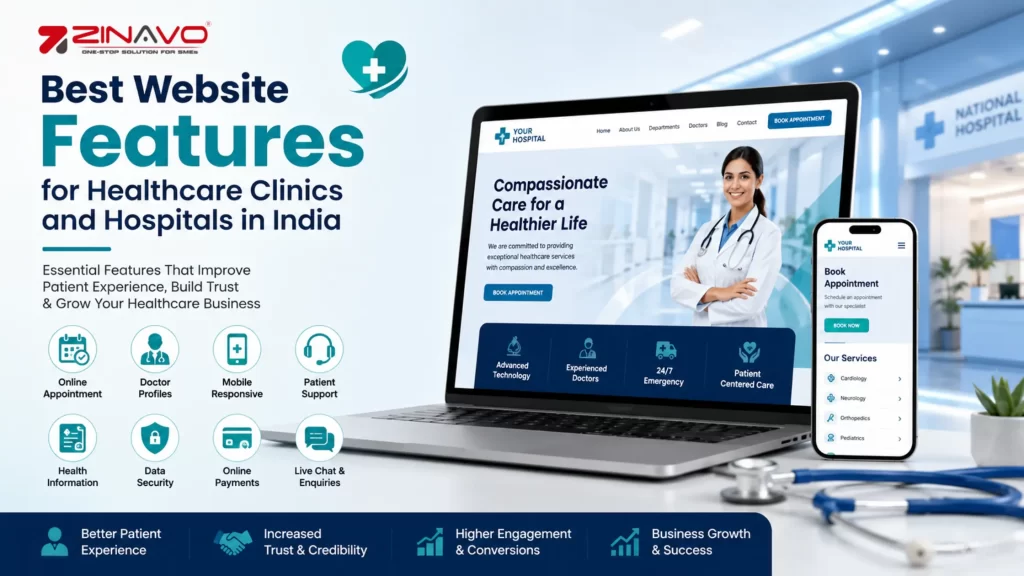
Introduction
The healthcare industry in India is undergoing a significant digital transformation. Patients are increasingly relying on online platforms to search for doctors, compare hospitals, book appointments, access medical information, and even consult healthcare professionals remotely. In this evolving digital landscape, a hospital or clinic website is no longer just an informational platform; it has become an essential tool for patient acquisition, engagement, and retention.
Modern healthcare consumers expect convenience, transparency, and accessibility. Whether they are looking for specialist consultations, diagnostic services, emergency care, or telemedicine options, patients prefer healthcare providers that offer seamless digital experiences. A professionally designed healthcare website development can help hospitals and clinics establish credibility, improve patient communication, and deliver exceptional care experiences.
As we approach 2026, healthcare organizations in India must adopt advanced website features that align with changing patient expectations and technological innovations. A feature-rich website can improve operational efficiency, streamline administrative tasks, enhance patient satisfaction, and ultimately contribute to long-term growth. This comprehensive guide explores the most important website features every healthcare clinic and hospital should implement to remain competitive in the digital healthcare ecosystem.
Why Healthcare Websites Are Crucial in 2026
The digital healthcare revolution has fundamentally changed how patients interact with healthcare providers. Before visiting a clinic or hospital, most patients conduct extensive online research. They review doctor profiles, read patient testimonials, compare facilities, and assess service quality through websites and online reviews.
A modern healthcare website serves multiple purposes beyond marketing. It acts as a virtual front desk, a patient education platform, a communication hub, and an appointment management system. By integrating advanced functionalities, healthcare organizations can significantly improve patient experiences while reducing manual administrative burdens.
Furthermore, the growing adoption of smartphones and internet accessibility across urban and rural India has accelerated the demand for digital healthcare services. Hospitals that fail to establish a strong online presence risk losing potential patients to competitors offering superior digital experiences.
Essential Features of a Hospital Website
| Feature | Importance | Key Benefits |
| Responsive Design | Ensures usability across devices | Better user experience and SEO |
| Appointment Booking | Simplifies scheduling | Reduced administrative workload |
| SEO Optimization | Improves search visibility | Increased patient inquiries |
| Telemedicine Integration | Enables virtual consultations | Expanded patient reach |
| Patient Portal | Provides secure access to records | Enhanced patient engagement |
| Online Payment Gateway | Simplifies billing processes | Faster and secure transactions |
| Doctor Profiles | Builds credibility | Improves patient trust |
| Live Chat Support | Facilitates communication | Instant patient assistance |
| Multilingual Support | Enhances accessibility | Serves diverse audiences |
| Data Security | Protects sensitive information | Ensures patient confidence |
| AI Chatbot | Offers 24/7 assistance | Improved response times |
| Reviews and Testimonials | Strengthens reputation | Higher conversion rates |
| Analytics Integration | Measures performance | Better decision-making |
Responsive and Mobile-First Website Design
A responsive website design has become indispensable for healthcare providers because the majority of healthcare-related searches now occur on mobile devices. Patients frequently search for hospitals, emergency services, specialist doctors, and nearby clinics while using smartphones. If a healthcare website does not load properly on mobile devices, users are likely to leave immediately and seek alternatives.
Responsive design ensures that a website automatically adjusts its layout, images, navigation menus, and content according to the user’s screen size. Whether accessed through smartphones, tablets, laptops, or desktop computers, the website should provide a consistent and seamless experience.
A mobile-first design approach prioritizes speed, simplicity, and usability. Features such as click-to-call buttons, easy appointment booking forms, location maps, and accessible navigation significantly enhance patient convenience. Moreover, search engines like Google prioritize mobile-friendly websites in search rankings, making responsive design an essential SEO factor.
Key Elements of Responsive Design
| Component | Purpose |
| Mobile Optimization | Improves smartphone usability |
| Fast Loading Speed | Reduces bounce rates |
| Touch-Friendly Navigation | Enhances accessibility |
| Click-to-Call Features | Enables instant communication |
| Optimized Images | Improves page performance |
Smart Online Appointment Booking System
The traditional process of scheduling appointments through phone calls often leads to delays, missed opportunities, and increased administrative workloads. In 2026, patients expect instant appointment booking capabilities directly from a healthcare provider’s website.
An intelligent appointment booking system allows patients to view available time slots, choose preferred doctors, schedule consultations, and receive immediate confirmation notifications. This self-service functionality enhances convenience while reducing dependency on front-desk staff.
Advanced appointment systems can also automate reminders through email, SMS, and WhatsApp, significantly reducing no-show rates. Integration with hospital management systems enables real-time synchronization of doctor schedules, ensuring accurate appointment availability.
Modern booking platforms increasingly incorporate Artificial Intelligence to suggest optimal appointment timings based on patient preferences, doctor availability, and urgency levels. Such intelligent scheduling improves resource utilization and patient satisfaction simultaneously.
Telemedicine and Virtual Consultation Integration
Telemedicine has transformed healthcare delivery in India by enabling patients to consult healthcare professionals remotely. The widespread acceptance of virtual consultations has made telemedicine integration an essential website feature for healthcare organizations.
Patients living in remote areas, elderly individuals, and those requiring follow-up consultations particularly benefit from telemedicine services. Virtual consultations reduce travel time, improve healthcare accessibility, and facilitate continuous care management.
A comprehensive telemedicine platform should include secure video conferencing, digital prescription generation, file-sharing capabilities, virtual waiting rooms, and integrated payment systems. Additionally, hospitals can offer remote monitoring services for chronic disease management through connected healthcare technologies.
Telemedicine integration not only expands patient reach but also enhances healthcare delivery efficiency by optimizing doctor availability and reducing physical crowding in healthcare facilities.
Search Engine Optimization (SEO)
Even the most sophisticated healthcare website cannot generate meaningful results if patients cannot find it online. Search Engine Optimization plays a vital role in increasing visibility and attracting potential patients through organic search results.
Healthcare SEO involves optimizing website content, technical structure, and local search presence to rank higher on search engines. Most patients search using terms such as “best cardiologist near me” or “multispeciality hospital in Bangalore.” Appearing prominently for such searches significantly influences patient acquisition.
Local SEO is particularly important for healthcare organizations because patients typically seek nearby services. Optimizing Google Business Profiles, location pages, and local keywords enhances visibility within geographic regions.
Technical SEO factors including website speed, mobile responsiveness, structured data markup, secure connections, and optimized URLs further contribute to improved rankings and user experiences.
Comprehensive Doctor Profiles
Patients increasingly prefer to learn about healthcare professionals before scheduling appointments. Detailed doctor profiles build confidence, establish credibility, and support informed decision-making.
A professional doctor profile should include educational qualifications, years of experience, medical specializations, certifications, research publications, awards, languages spoken, consultation timings, and professional achievements.
Including patient reviews, success stories, and video introductions can further humanize healthcare providers and foster stronger patient relationships. Transparent information helps reduce uncertainty and encourages appointment bookings.
Healthcare organizations should regularly update doctor profiles to reflect current achievements, new certifications, and revised schedules.
Secure Patient Portal
Digital healthcare experiences extend beyond appointments. Modern patients expect secure access to their medical information anytime and from anywhere.
A patient portal enables individuals to access laboratory reports, prescriptions, consultation histories, billing details, and treatment records securely through personalized accounts. Such accessibility promotes transparency, improves patient engagement, and encourages proactive healthcare management.
Patient portals also facilitate secure communication between doctors and patients, allowing follow-up consultations, document sharing, and medication reminders. By digitizing medical records, hospitals can reduce paperwork, minimize errors, and improve operational efficiency.
Strong authentication mechanisms, encrypted communications, and regulatory compliance measures are essential to protect sensitive health information.
AI-Powered Chatbots and Virtual Assistants
Artificial Intelligence has emerged as one of the most significant trends in healthcare website development. AI-powered chatbots provide instant assistance to website visitors around the clock.
These virtual assistants can answer frequently asked questions, guide users to appropriate departments, assist with appointment bookings, provide service information, and collect preliminary patient details.
Advanced healthcare chatbots are increasingly capable of multilingual conversations, voice interactions, symptom assessments, and personalized recommendations. Such capabilities improve accessibility while reducing the workload on support teams.
By offering immediate responses and continuous availability, AI chatbots significantly enhance patient experiences and increase engagement rates.
Multilingual Website Support
India’s linguistic diversity necessitates multilingual website capabilities for healthcare organizations serving broad populations. Offering content in multiple languages ensures inclusivity and improves communication effectiveness.
Patients often feel more comfortable accessing healthcare information in their native language. Multilingual websites can substantially improve comprehension, reduce misunderstandings, and encourage healthcare utilization.
Languages commonly supported include English, Hindi, Kannada, Tamil, Telugu, Malayalam, Bengali, and Marathi. Emerging AI-based translation technologies further simplify multilingual content management.
Healthcare providers catering to regional audiences should prioritize localization to enhance patient trust and accessibility.
Online Payment Gateway Integration
Digital payments have become standard across India’s healthcare ecosystem. Patients increasingly expect secure online payment options for consultations, diagnostics, procedures, and hospital bills.
Integrated payment gateways streamline financial transactions, reduce manual billing processes, and improve operational efficiency. Supporting multiple payment methods such as UPI, credit cards, debit cards, net banking, and digital wallets ensures convenience for diverse patient groups.
Secure payment processing with encryption and fraud prevention mechanisms is essential for maintaining patient confidence and protecting financial information.
Patient Reviews and Testimonials
Online reputation significantly influences healthcare decisions. Positive patient experiences shared through testimonials and reviews establish trust and encourage new patient inquiries.
Healthcare websites should prominently showcase authentic patient feedback, success stories, video testimonials, and satisfaction ratings. Integrating Google reviews further strengthens credibility.
Transparent review management demonstrates commitment to quality care while providing valuable insights for continuous improvement.
Conclusion
Healthcare websites Development in 2026 must evolve beyond traditional informational platforms to become comprehensive digital healthcare ecosystems. Features such as responsive design, appointment scheduling, telemedicine, AI-powered support, secure patient portals, and advanced SEO are no longer optional—they are essential.
Hospitals and clinics that embrace these innovations can improve patient experiences, streamline operations, expand their reach, and maintain a competitive advantage in India’s rapidly evolving healthcare landscape. Investing in modern website features today will position healthcare organizations for sustained success in the digital future.